Every farmer wants his buffalo or cow to give more milk, and the market is full of injections, powders and "desi nuskhe" that promise it. The truth is simpler. Milk does not rise because of one thing. It comes from six: enough feed, good fodder, clean water, relief from heat, the right way of milking and a healthy animal. If one of them is weak, the others cannot make up for it.
If you have searched "bhains ka doodh kaise barhaye" or "gaye ka doodh barhane ka tarika", this guide covers each of the six in plain steps.
The short answer
To increase a buffalo's or cow's milk:
1. Give wanda by her milk, on top of what her body needs: 1 kg for every 2.5 to 3 litres of cow milk, or for every 2 to 2.5 litres of buffalo milk. 2. Give good green fodder and straw alongside it. 3. Keep clean water in front of her all the time. 4. In summer, give shade, fans, and a bath or water spray. 5. Milk her at the same times every day, calmly and completely. 6. Treat udder infection, worms and illness early.
And one thing not to do: do not use the milk let-down injection (oxytocin) on your own.
First understand where milk comes from
Milk is made inside the animal from the feed and water she takes in. The first share of everything she eats goes to her own body: keeping her alive, warm and healthy. Only what is left over becomes milk.
So when feed is short, she feeds herself first and the milk falls. This is why no "milk-raising medicine" works while the feed is incomplete. Fix the feed first.
1. Wanda: how much, and which one
Think of wanda in two parts:
- **The body's own share:** about 1 kg a day for a desi cow, and about 1.5 kg for a crossbred cow or a buffalo. Less when there is plenty of good green fodder.
- **The milk share:** 1 kg for every 2.5 to 3 litres of cow milk, or for every 2 to 2.5 litres of buffalo milk. Buffalo milk carries more fat, so it takes more feed to make.
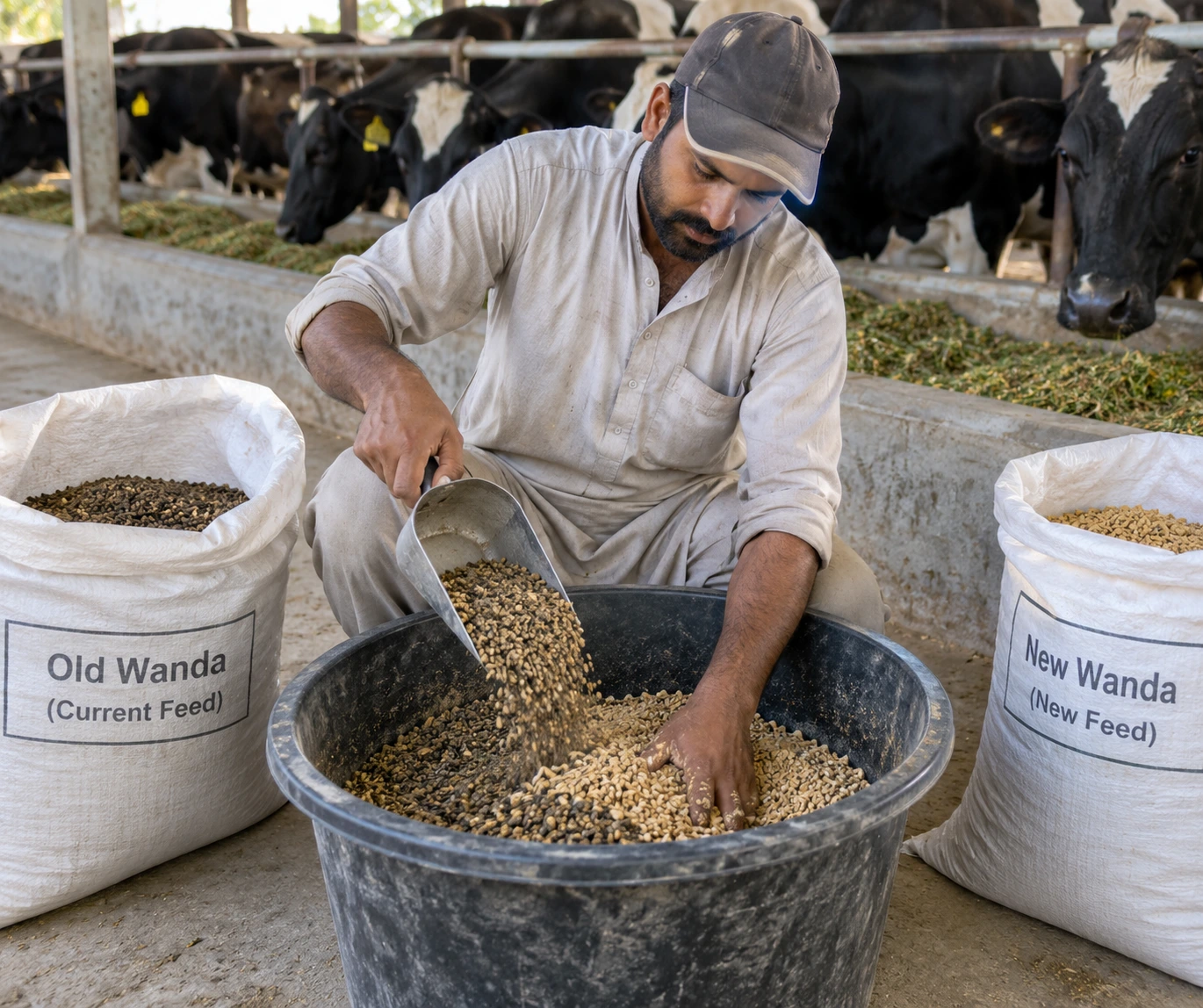
For example, a buffalo giving 10 litres needs about 1.5 kg for her body plus 4 to 5 kg for the milk: roughly 5.5 to 6.5 kg a day. Many farmers give only the milk share and then wonder why the animal loses condition and the milk slides. Our feed calculator works this out for your animal.
Split the day's wanda into two or three feeds. A large amount at once upsets the rumen.
Which wanda depends on the daily milk:
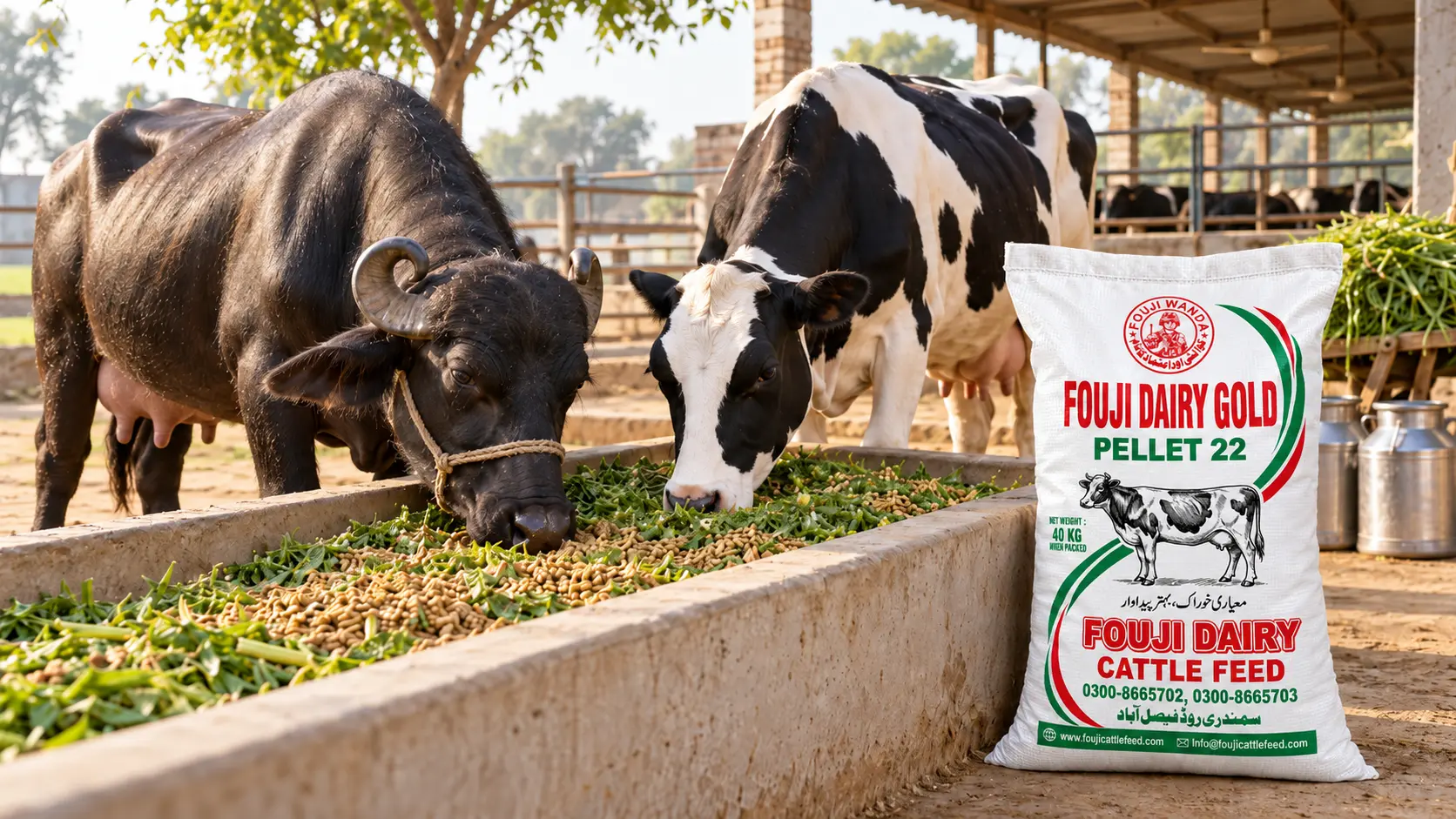
- On pellet: Dairy Gold 18 Pellet up to 14 litres a day, and Fouji Dairy Gold 22 above 14 litres. Dairy Gold 22 also contains bypass fat.
- On mash: A+ Wanda for average yields, Special Wanda for high-yielding cows and buffaloes, and Karachi Wanda, made especially for milking buffaloes.
More detail is in Which is the best wanda for milk?
One warning: more wanda does not always mean more milk. If the fodder is poor or the water is short, extra wanda is wasted. And never raise the amount suddenly; increase it over seven to ten days.
2. Green fodder and straw
Wanda is only half the diet. The other half is fodder, and good fodder saves wanda.
- **Winter:** berseem is excellent green fodder.
- **Summer:** maize, sorghum (jowar) and millet (bajra).
- **When fodder is short:** silage made in good months carries the farm through the lean months.
- **Straw (toori):** gives the long fibre the rumen needs. Without enough fibre, milk fat is the first thing to fall.
Do not chop fodder too fine, and keep some fodder in front of the animal through the day.
3. Clean water, all the time
Milk is mostly water, and a milking buffalo drinks a great deal every day. An animal that gets water only twice a day, or from a dirty trough, drinks less, eats less and gives less milk. Keep clean, fresh water in front of her all day, and give water soon after milking. In summer this matters even more.
4. Protect her from heat
Heat is one of the biggest reasons milk falls in Punjab summers, and buffaloes suffer more than cows. Their dark skin takes in heat and they sweat very little, so they need help to cool down.
- Let the buffalo wallow in a pond, or bathe her or spray her with water two or three times in the hot hours.
- Give good shade and, if you can, fans.
- Feed in the cooler hours: early morning and evening.
- Keep water close and cool.
Cows also need shade, air and water in summer. A cooled animal eats better, and her milk falls less.
In winter, protect animals from cold wind and give dry bedding. In the cold the body burns a little more feed just to stay warm.
5. Milk the right way
How you milk affects how much milk you get:
- Milk at the same times every day. A changing routine lowers the milk.
- Keep the animal calm. Fear and shouting stop the milk from letting down.
- Wash your hands, and clean and dry the udder before milking.
- Milk out completely. Milk left in the udder tells the body to make less.
- Milk with the full hand, not by pressing with the bent thumb, which hurts the teat.
- A high-yielding animal can be milked three times a day instead of two, which usually brings more milk.
For let-down, a few seconds of washing and gently massaging the udder, or having the calf nearby, works better than any injection.
6. Keep her healthy
Many "feed problems" are really health problems:
- **Udder infection (mastitis):** a hard or hot teat, clots, blood or watery milk. Call a vet the same day. A clean, dry floor prevents much of it.
- **Worms:** an animal carrying worms turns feed into worms, not milk. Deworm on your vet's schedule.
- **Vaccination:** get the haemorrhagic septicaemia (gal ghotu) and foot-and-mouth (mooh khur) vaccines on time.
- **Fever or going off feed:** these are health questions, not feed questions.
Next year's milk is made before calving
Many farmers forget this. How much milk a buffalo or cow gives after calving depends a lot on how she was fed before it.
- Give her a dry period of about the last two months before calving, so the udder can rest and rebuild.
- Keep her body condition good during the dry period: not thin, not fat. A+ Wanda suits the dry period.
- After calving, raise her wanda slowly as her milk rises. Milk climbs to its highest in the first two or three months, and how high it climbs decides the milk for the whole lactation.
- Give the newborn its first milk (colostrum) quickly.
The truth about desi nuskhe and injections
**Desi nuskhe:** most home remedies that seem to work do so because they add energy or protein, which means they are filling a gap in the feed. There is no magic recipe. When the feed is complete, the animal does not need one.
**The let-down injection (oxytocin):** in Pakistan this injection is widely misused to make animals let down milk. It is a medicine for a vet to use for treatment, not a daily habit. With regular use the animal can become dependent and stop letting down milk without it, and farmers report problems with breeding as well. Do not use it on your own.
**Milk-raising powders, syrups and calcium:** if an animal is short of calcium or minerals, give them on a vet's advice. But no bottle raises milk if the feed and water are short. A good dairy wanda already contains dairy premix and DCP.
If milk suddenly drops
Check these before blaming the feed:
- Was the feed or fodder changed suddenly?
- Is water short or dirty?
- Is it very hot?
- Any sign of udder infection?
- Fever, or eating less?
- Is she in heat? Milk often dips for a day or two.
- Has she been moved, frightened or transported?
If she has a fever or has stopped eating, call a vet.
How to raise milk fat
Fat comes mainly from fibre digested in the rumen. So give enough straw and long fodder, do not give all the wanda at once, and do not chop fodder too fine. Buffalo milk naturally has more fat than cow milk. A feed with bypass fat, such as Fouji Dairy Gold 22, gives high-yielding animals extra energy.
How long before you see a difference?
Change any feed slowly, over seven to ten days, then give it two to three weeks before you judge it. An animal late in her lactation will not climb back up, but good feeding slows the fall, and that is real money too.
Keep a notebook: the date, the litres, and anything unusual. Without a record you are comparing today's memory with last month's. The day-by-day method is in our guide on switching to a new wanda.
Frequently asked questions
**What should I feed a buffalo to increase milk?** Wanda by her milk (1 kg for every 2 to 2.5 litres, on top of about 1.5 kg for her body), good green fodder, straw and clean water all day. In summer, cooling matters as much as feed.
**Does giving more wanda alone increase milk?** Not on its own. If fodder, water or health is the problem, more wanda is wasted. Balance the whole diet.
**Why does a buffalo's milk drop suddenly?** Usually a sudden feed change, heat, short water, udder infection, illness, or coming into heat.
**Is the milk injection safe to use?** No, not as a habit. Use it only when a vet prescribes it for treatment.
**Is there a desi nuskha to increase milk?** There is no magic nuskha. Complete feed, fodder and water work better than any home remedy.
**How can I increase milk in summer?** Cool the animal with a bath or water spray, give shade and fans, feed in the cool hours and keep water in front of her all day.
Ask us
Tell us whether it is a buffalo or a cow, how many litres she gives a day and what fodder you have. Contact us and we will tell you which Fouji Wanda suits her, and today's rate.
This article offers general guidance for farm management and is not a substitute for advice from a qualified veterinarian or animal nutritionist.