On most farms in Pakistan, goats and sheep are kept together, fed together and thought about together. They do not eat the same way, and at some points in the year they do not need the same thing at all.
Goats browse, sheep graze
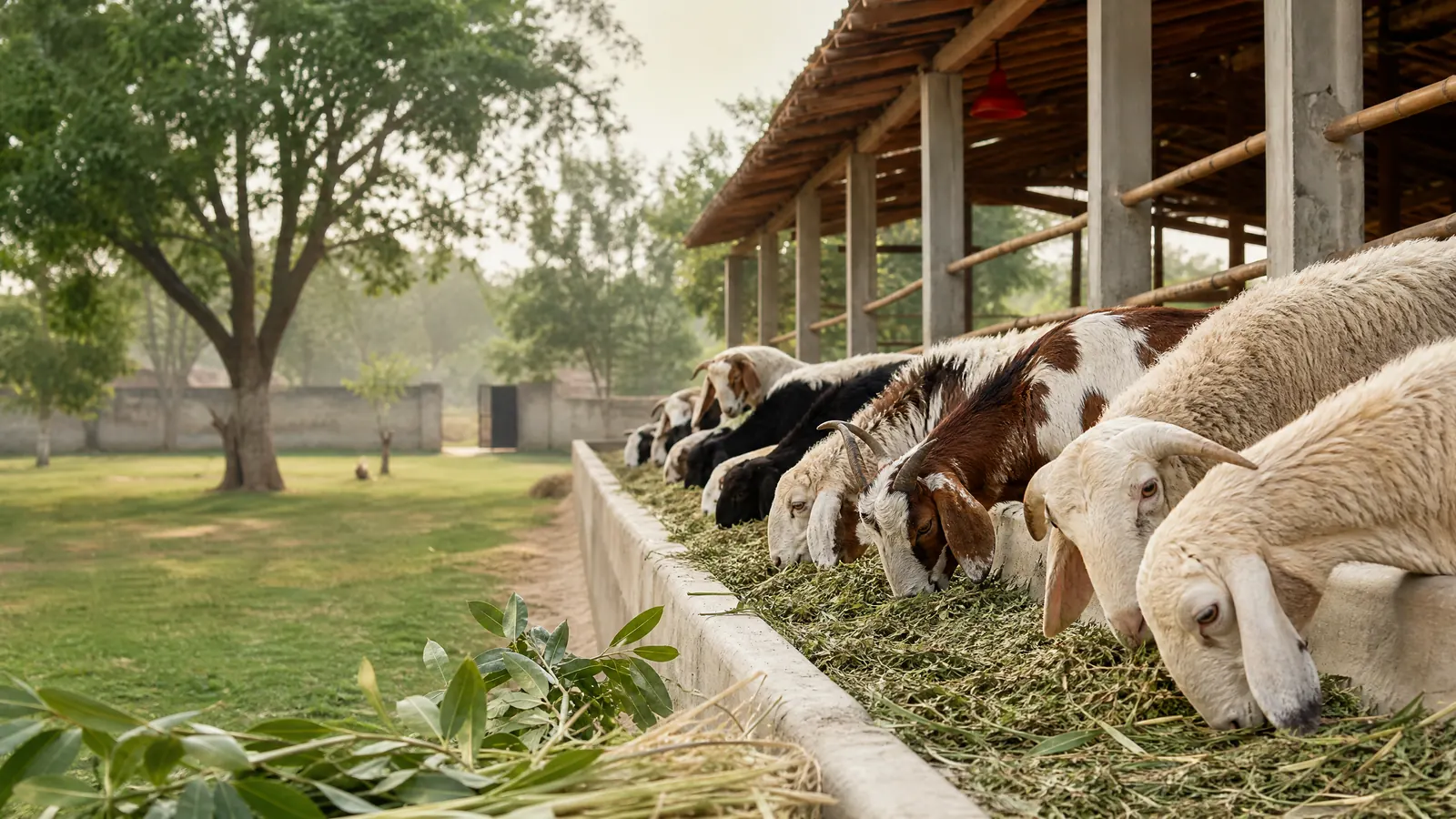
Left alone, a goat reaches up. It prefers leaves, shrubs and tree branches, and picks at a wide variety through the day. A sheep puts its head down and grazes close, and will work the same patch of grass steadily for hours.
That changes what happens in the shed. Goats sort through feed and leave what they do not fancy, so in a loose mash they pick out the grain and leave the fine mineral portion at the bottom. Goats also waste a great deal of fodder thrown on the floor — a raised rack pays for itself in a season. Sheep are far less fussy and will clean up much of what goats reject.
It also changes who gets fed. Put both in one pen with one trough and the pushy animals eat twice while the timid ones go short. Trough space is not a detail; it is the difference between an even group and a group with three animals falling behind.
How much should I feed a goat or sheep per day?
Work from body weight, not from a scoop.
Total daily dry feed — fodder and concentrate together — runs at roughly 3 to 4 percent of body weight. So a 30 kg goat eats about 1 to 1.2 kg of dry matter a day in total.
How much of that should be concentrate depends on what you are asking the animal to do:
- Maintenance only, with decent grazing: often no concentrate at all, or a few hundred grams
- Growing kids and lambs: about 1.5 to 2 percent of body weight
- Late pregnancy and milking does: about 2 to 2.5 percent
- Fattening for sale: about 2.5 to 3 percent
Split it across two feeds rather than one, keep fodder in front of them all day, and keep clean water within reach at all times. An animal short of water eats less, and it looks exactly like a feed problem.
Our feed calculator will give you a starting amount from the animal's weight.
What protein does each animal need?
- Growing kids and lambs: 16 to 18 percent
- Late pregnancy, milking does and fattening animals: 16 to 18 percent
- Adults on maintenance: 12 to 14 percent is enough, and more is simply wasted money
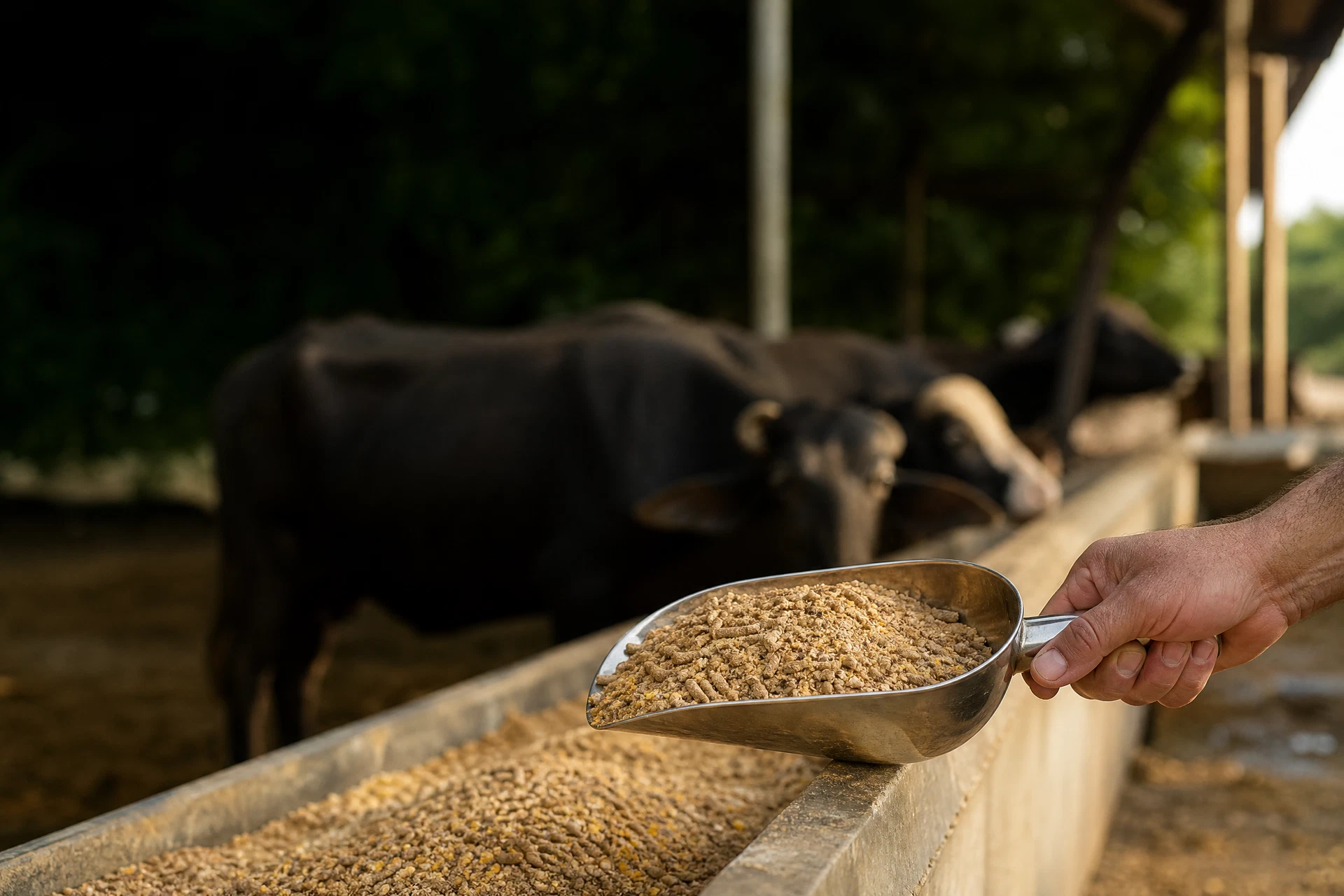
Fouji Goat Max is 16 to 18 percent protein in a 20 kg bag, available in pellet and mash — the band that suits growing, fattening and milking animals.
The last six weeks of pregnancy decide your kid crop
If there is one period where feed quietly earns or loses you money, this is it, and it is the one most often missed.
About 70 percent of the kid's or lamb's growth happens in the final four to six weeks before birth. Over that stretch the mother's energy and protein needs rise by roughly 50 to 75 percent above where they were in early pregnancy.
Here is the trap. At exactly the moment she needs more, she can eat less — the growing kids take up room that the rumen used to have. So filling her with bulky fodder does not work. She needs the same nutrition in a smaller volume, which is what concentrate is for.
Start adding concentrate about six weeks before she is due. Begin at roughly a quarter of a kilo a day and work up to around three quarters of a kilo by kidding, alongside her normal fodder.
An animal carrying twins needs close to twice the intake of one carrying a single, so if you know she is carrying more than one, feed her accordingly and do not leave her at the back of the group.
Underfeed her here and you get a condition farmers know by its results before its name: she goes off feed in the last fortnight, stands apart, droops her head, lags behind the others, grinds her teeth, and then goes down. That is pregnancy toxaemia, and by the time it is obvious it is often too late. It is a feeding failure, not bad luck — and the animals most at risk are the ones carrying twins, the ones too thin, the ones too fat, and the timid ones being pushed off the trough.
Well-fed mothers give birth to stronger kids, produce more milk afterwards and come back into condition faster. This is the cheapest six weeks of feed you will buy all year.
Fattening for Eid: what is realistic
This is where farmers lose money to their own arithmetic, so here are honest numbers.
In a trial on male Beetal goats in Punjab, animals averaging 34 kg on chopped sorghum fodder plus 0.75 kg of concentrate a day — about 2.2 percent of body weight — gained roughly 120 grams a day across three summer months.
So plan on 100 to 175 grams a day. Good breeding, cooler weather and strong fodder push you towards the top of that range; summer heat pushes you to the bottom.
What that means in practice: a 25 kg kid gaining 130 grams a day for 100 days finishes at about 38 kg. If your plan needs it to reach 50 kg in that time, the plan is wrong, not the feed.
Start 90 to 120 days before Eid, not three weeks before. An animal cannot be rushed at the end, and trying to rush it is how you get a digestive upset in the last fortnight — at the exact moment the animal is worth the most.
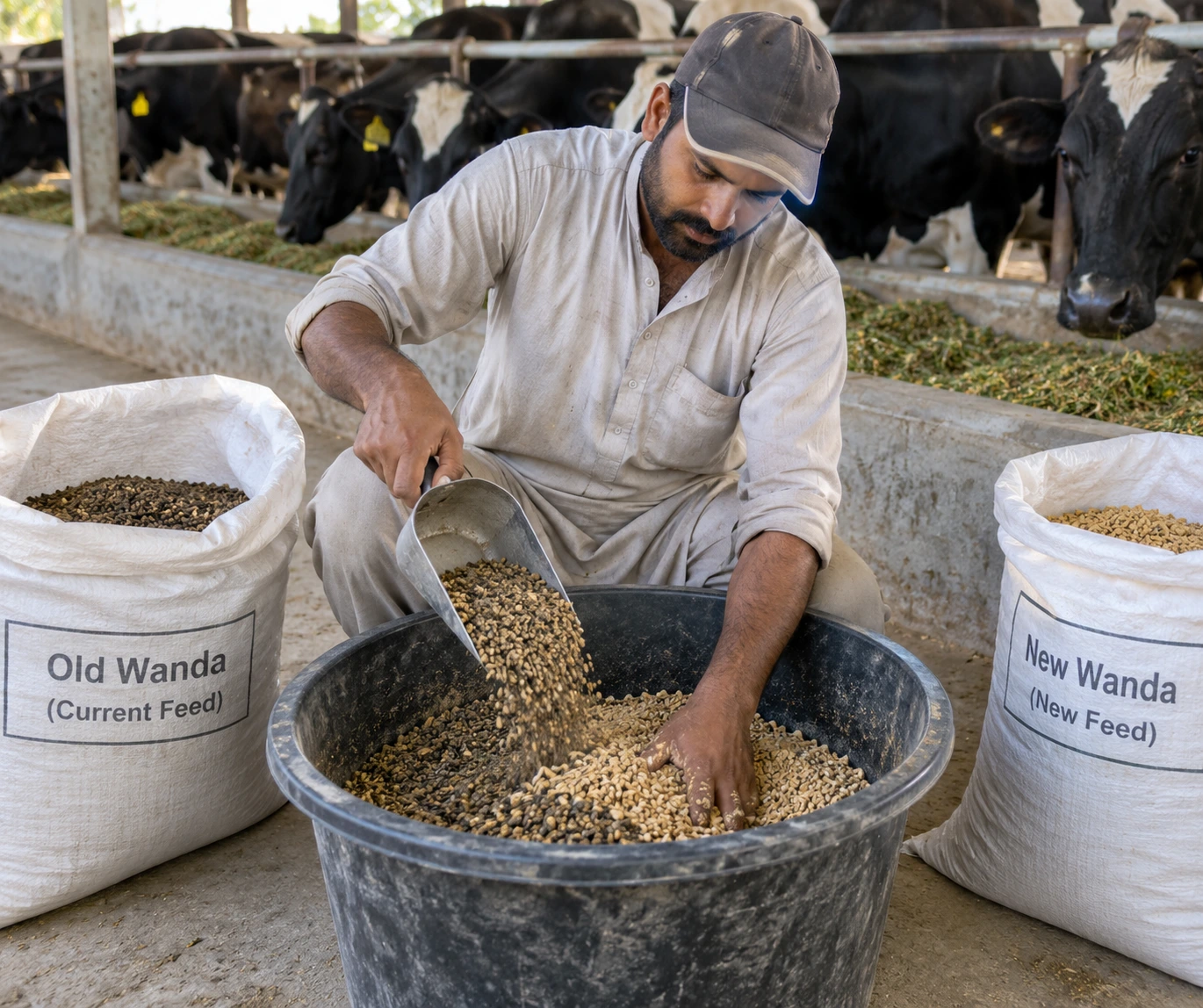
Bring the concentrate up over seven to ten days when you start, never in one go. The method is the same as for cattle and is set out in our guide on switching to a new wanda. You can also see the full Fouji feed range.
Watch these every day
- Is the animal coming to the feed, or standing back from the group?
- Are the droppings firm and pelleted, or loose?
- Is the water clean, and can the smallest animal reach it?
- Any coughing, nasal discharge or lameness?
- Is anyone being pushed off the trough? Horned and hornless animals do not feed equally.
Two things that quietly cost more than feed
Worms come first. In our climate, internal parasites take more growth from small ruminants than poor feed does. An animal carrying a worm burden will not gain whatever you feed it, and you will blame the bag. Follow a deworming programme set with your veterinarian.
Heat comes second. Through a Punjab summer, intake falls on its own. Shade and water do more for weight gain in June than any change of feed.
Talk to us
Tell us whether they are goats or sheep, how many, their rough weight, and whether you are growing them, breeding them, milking them or fattening them for Eid. Get in touch and we will help you work out the daily amount.
This article offers general guidance for farm management and is not a substitute for advice from a qualified veterinarian or animal nutritionist. Every animal and every farm situation is different.